Introduction
There are over 4 million South Africans living with Diabetes. The condition is identified by high glucose (sugar) levels in the blood. Left uncontrolled it leads to complications. The HbA1c test is one of the most important tests used in the diagnoses and management of diabetes.
What is the test about?
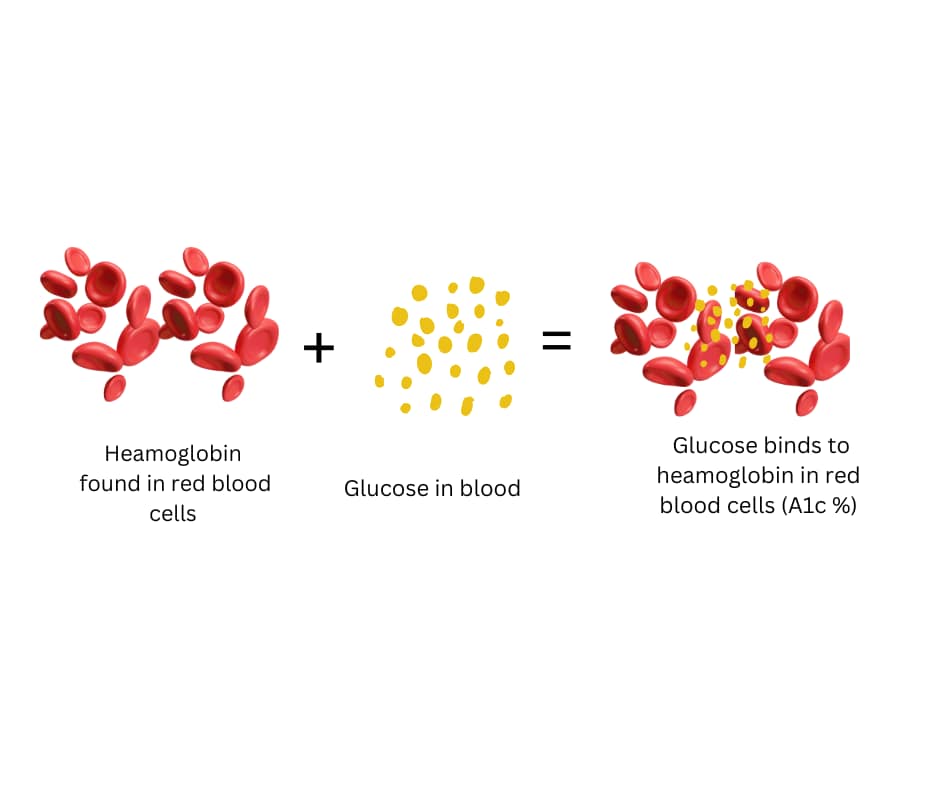
The test gives a picture of what has been happening with glucose control over a period of 3 months. When glucose levels in the blood are increased, glucose sticks to heamoglobin. Heamoglobin (Hb) is a substance found in the red blood cells. Its main duty is to transport oxygen in the blood.
Red blood cells live for 90-120 days. The test measures the amount of heamoglobin with glucose stuck on it. The higher the glucose levels the more glucose will stick to heamoglobin. The result is given as a percentage.
| Normal | Less than 5.7% |
| Pre-Diabetic | 5.7% – 6.5% |
| Diabetic | More than 6.5 % |
How is it different from other tests done in Diabetes ?
Normal finger prick tests done in Diabetes give a picture of what is happening with glucose control at that particular moment. They are affected by stress and illness. The HbA1c test on the other hand gives us a summary of what has been happening over the last 3 months, and is not affected by everyday stress. Studies have however shown that prolonged stress can affect HbA1c .
How often should the test be done ?
SEMDSA (Society for Endocrinology, Metabolism and Diabetes of South Africa) guidelines states that the test should be done on all diabetic patients at first appointment and on a regular basis as part of their care plan. The recommended interval is every 3- 6 months. Six monthly for those doing well on treatment and hitting targets, and every 3 months for those not yet stable on treatment.
HbA1c targets
The guideline recommends individualized HbA1c targets. Your doctor will guide you in setting your HbA1c targets after looking at all your risk factors. The table below provides a guide of the recommended targets
| Majority of Patients | Less than or equal to 7% |
| New patients | Less than 6.5 % |
| Elderly | 7% – 8 % |
Conclusion
A higher HbA1c reading tells a story of poor blood glucose control over the last 3 months. The higher the number the higher the risk of developing complications from Diabetes .
Pingback: 6 factors to consider when choosing Type 2 Diabetes medication. – Your Medication Working For You
Pingback: Meet the Biguanides – Your Medication Working For You
Pingback: What are DPP4 inhibitors and how do they work? – Your Medication Working For You
Pingback: GLP 1 Agonists – Your Medication Working For You
Pingback: Meet the Sulfonylureas – Your Medication Working For You
Pingback: SGLT2 inhibitors – Your Medication Working For You
Pingback: Postprandial Blood Glucose and its effect on HbA1c and Heart Health explored. – Your Medication Working For You
Pingback: Prevention of common Type 2 Diabetes complications – Your Medication Working For You
Pingback: Food and blood glucose control – Your Medication Working For You
Pingback: Empowered living: Mastering Self-Care for Type 2 Diabetics. – Your Medication Working For You