History of Vitamins
It was in 1912 that Dr. Casimir Funk introduced the idea of vitamins to the world. Dr. Funk suggested that certain medical conditions like beri-beri, scurvy and rickets could be treated by these substances found in food. His writings sparked interest in both the medical and scientific world.
Within a space of 35 years, thirteen vitamins as we know them had been identified. These are the eight known B- Vitamins, Vitamin C, and the 4 fat soluble Vitamins A, D, E and K.
| B1 | Thiamine |
| B2 | Riboflavin |
| B3 | Niacin |
| B5 | Pantothenic acid |
| B6 | Pyridoxine |
| B7 | Biotin |
| B9 | Folic/Folate |
| B12 | Cobalamin |
In 1941 the National Nutritional Conference for Defense was convened by US President Franklin D. Roosevelt. World War II (1939-1945) was in full swing, and countries including America were still recovering from the Great Depression (1929-1939). Several of the young men being called up for duty were found to suffer from medical conditions associated with poor nutrition. What came out of that conference was the first table of Recommended Daily Allowances (RDAs). In 1943 the first one- a -day multivitamin appeared on the market.
Since the initial discovery of vitamins, products containing multivitamins and other ingredients started entering the market. These products promised consumers additional health benefits and relief from ailments. These miracle products were advertised in newspapers and magazines. Celebrities were brought on board to promote them, an example of one such celebrity endorsement was the Vimms Vitamin Show, with Frank Sinatra which was on CBS (an American TV network).
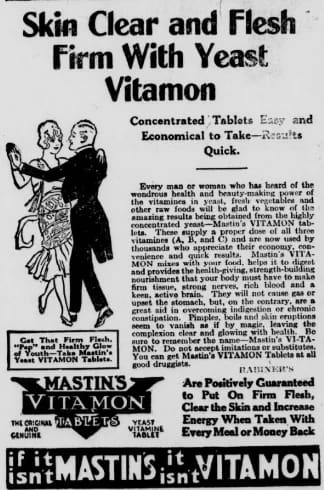
Popular 1920 vitamin supplement advert
While these products gained popularity and acceptance with the public, healthcare professionals and government regulators remained skeptical. Commentators on the use of dietary supplements have been quoted as saying that the use of such products result in nothing other than expensive urine, while others have called it, just plain medical quackery.

1958 Statement by Arthur S Flemming: US Secretary of Health, Education and Welfare (1958-1961)
What are dietary supplements?
Dietary supplements refer to any product that is, taken by mouth and contains dietary ingredients. Their main purpose is to support or improve one’s diet. They are available in different forms including capsules, tablets, powders, and syrups to name just a few.
Options available to users vary as products are further classified by age and gender. It is important to note that different terminology may be used in different countries to describe the same products. Common names used include health supplements, natural health products and complementary medicines, a term also used in South Africa.
In 2023 the global market value of dietary supplements was estimated at USD 178 billion and is expected to reach USD 327 billion by 2030.
| Vitamins & Minerals | Probiotics |
| Proteins and Amino acids | Prebiotics |
| Herbs or other Botanicals | Fats, Oils and Fatty Acids |
Safety and Regulatory issues.
Dietary supplements inhabit a no-man’s-land between food and pharmaceuticals. It would simply not be possible to implement pharmaceutical-style regulations for dietary supplements.
Rules governing the control of supplements is different to that of food and medication. Before a new medication can be sold to the public, the manufacturer is required to apply with that country’s regulatory body, FDA in the US and SAHPRA in South Africa. The manufacturer cannot sell their product until approval has been received from the relevant regulatory authority. The duty of the regulatory body is to ensure that all medication sold to the public is safe.
In South Africa if you pick up a bottle of your favorite supplement, you will notice a disclaimer on the label informing you that the product has not been tested for safety by the regulatory authority and that it is not intended to diagnose, treat, cure, or prevent any disease. This is so because no premarketing approval is required in most countries for supplement to be sold to the public. Responsibility is left to the manufacturer to ensure that their products are safe, and that information communicated to the public about the product is truthful.
Regulatory authorities carry the responsibility of removing products from the market in cases where, there are reports of harm being caused by these products. One may argue that this is not enough as some of these harmful events result in hospitalisation or even death. Herbal ingredients used in dietary supplements have been shown to cause kidney damage. A recent example being the March 2024 recall of a Japanese health supplement that resulted in 5 deaths and over 100 people hospitalised due to suspected kidney damage.
A US study found that an estimated 20 000 Emergency Room (ER) visits every year, were as a result of unwanted reactions from dietary supplements. More than 2000 of these resulted in hospitalisation. Common ER complains mentioned are :allergic reactions, difficulty with breathing and increased heart rate. Products commonly associated with these complains included those used as performance enhancers as well as energy drinks.
Reports show that a common finding with recalled products, was the discovery of banned pharmaceutical ingredients included in some products. Contamination of products, as well as misleading labelling have also been found with health supplements. Misleading labelling refers to ingredients being listed on the label, but not found in the product or being found in amounts that do not match the label.
The decision to use supplements remains a personal one. Should one decide to use dietary supplements it is important that they take time to research the manufacturer. Especially if it is a new product on the market, or stick with manufacturers who have built a solid reputation when it comes to safety.
Vitamins still play a vital role in cases when one’s diet is lacking. They are also important in the clinical setting where one has been diagnosed with a deficiency. Vitamins are recommended at times when additional nutritional support is needed as in the case of pregnant and breastfeeding mothers. For anything else good nutrition remains the most reliable way for maintaining good health.